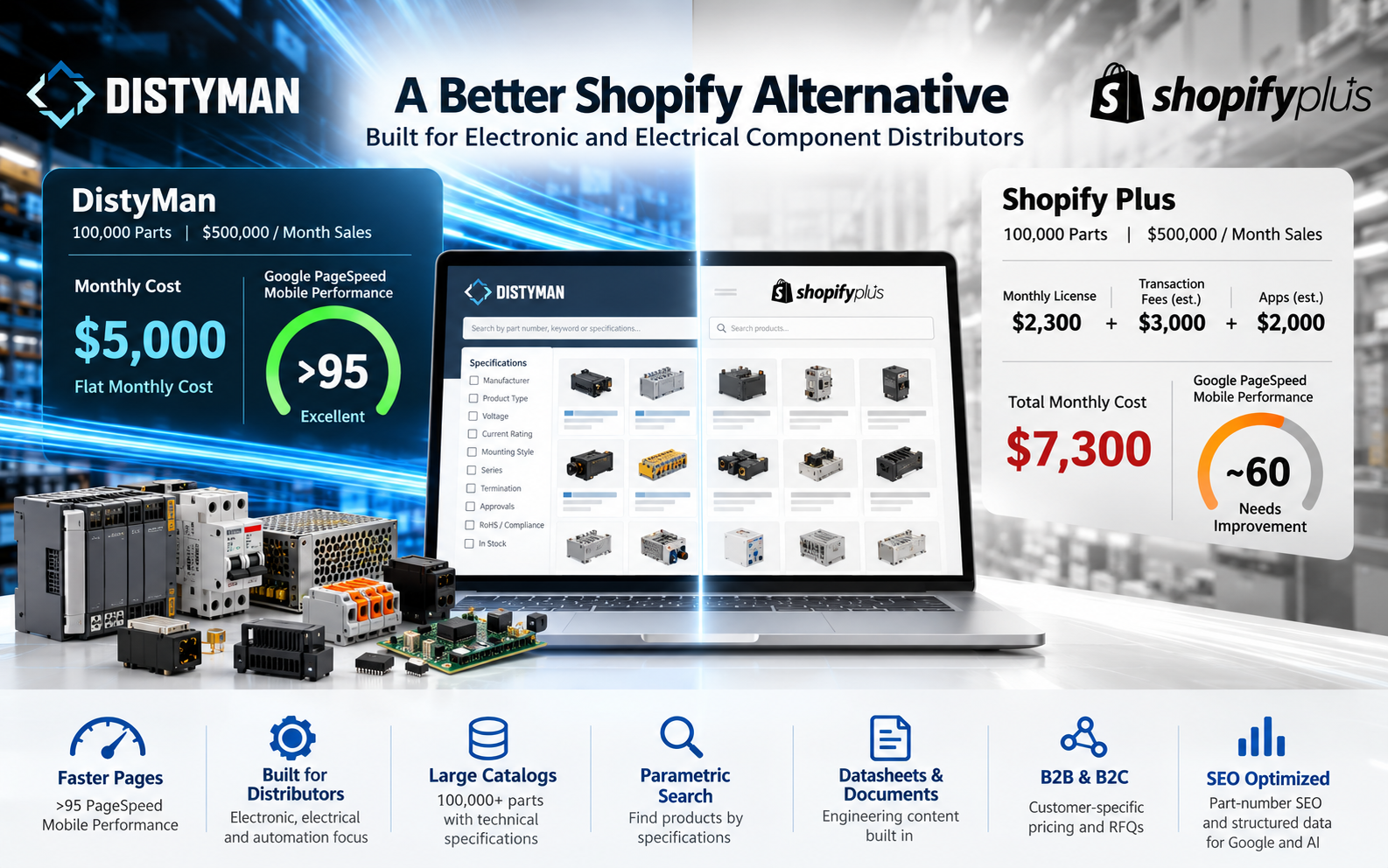
DistyMan vs. Shopify: A Shopify Alternative for Distributors with Large Product Catalogs
If you are searching for a Shopify alternative for a large B2B product catalog, the question may not be whether Shopify can sell your products. The better question is whether Shopify is the best platform for the way your company sells.
For retailers with conventional product catalogs, Shopify is one of the world's leading e-commerce platforms. It offers a large application ecosystem, sophisticated checkout capabilities, B2B functionality and a large developer community.
But a distributor selling 100,000 electronic, electrical, automation or industrial components has very different requirements from a traditional online retailer.
Large technical catalogs require more than a shopping cart. They need fast product pages, complex specifications, parametric search, manufacturer part-number indexing, datasheets, customer-specific pricing, RFQs, ERP integration and an SEO architecture capable of making tens or hundreds of thousands of product pages visible to Google and AI-powered search.
That is the market DistyMan was built to address.
Looking for a Shopify Alternative? Start With the Type of Products You Sell
Shopify is a general-purpose commerce platform.
DistyMan is an e-catalog and e-commerce platform focused specifically on electronic, electrical, automation and industrial products.
That distinction becomes increasingly important as a catalog grows.
A distributor with 100,000 products may need to manage:
- Manufacturer and manufacturer part number
- Hundreds or thousands of specification fields
- Product families and categories
- Technical descriptions
- Datasheets and engineering documents
- Product images
- Stock and availability
- Multiple customer price levels
- Quantity pricing
- RFQs
- Cross-reference products
- Related products
- ERP inventory and pricing
- Search-engine metadata
- Structured product data
Rather than adapting a retail-oriented platform to these requirements through multiple applications and customizations, DistyMan approaches them as fundamental parts of a distributor's e-commerce platform.
DistyMan vs. Shopify Plus: 100,000 Products and $500,000 in Monthly Sales
Consider an electronic or electrical distributor operating an e-commerce website with:
- 100,000 products
- $500,000 per month in online sales
- $6 million in annual online sales
Using the planning assumptions for this comparison, the cost structure looks very different.
| Cost | DistyMan | Shopify Plus |
|---|---|---|
| Platform / License | $5,000/month | $2,300/month |
| Estimated Transaction / Payment-Related Cost* | $0 platform transaction cost in this comparison | ~$3,000/month |
| Estimated Apps / Added Functionality* | Included in platform assumption | ~$2,000/month |
| Estimated Monthly Platform Cost | $5,000 | $7,300 |
| Estimated Annual Platform Cost | $60,000 | $87,600 |
| Difference | — | +$27,600/year |
At this scale, the lowest advertised license price does not necessarily represent the actual operating cost of an e-commerce platform.
Shopify Plus currently starts at approximately $2,300 per month on certain long-term agreements, but applications, payment processing, integrations, custom functionality and development can substantially change total operating cost.
For a distributor evaluating a Shopify Plus alternative, the better comparison is:
What does the complete solution cost to operate?
Not simply:
What is the monthly software license?
*Transaction/payment and app costs shown above are estimates for this 100,000-product, $500,000-per-month comparison scenario. Actual Shopify payment, application and integration costs depend on the merchant's configuration, payment processor, applications and negotiated terms.
Shopify vs. DistyMan PageSpeed Performance
Cost is only part of the comparison.
For a distributor with 100,000 product pages, website performance can directly affect SEO, user experience and conversion opportunities across the entire catalog.
| Mobile PageSpeed Comparison | DistyMan | Shopify |
|---|---|---|
| Google PageSpeed Mobile Performance | >95 | ~60 |
| Large Technical Catalog Optimization | Primary design objective | Implementation dependent |
| Third-Party Application Overhead | Minimized | Can increase as apps are added |
| Page Architecture | Optimized for technical catalogs | Theme/app dependent |
| SEO Performance Focus | Built around product and category visibility | Depends heavily on implementation |
It is important to distinguish a Google PageSpeed Performance Score from Google's Core Web Vitals.
PageSpeed Performance is reported on a 0–100 scale. Core Web Vitals use specific metrics such as Largest Contentful Paint, Interaction to Next Paint and Cumulative Layout Shift.
For this reason, we use PageSpeed mobile performance scores when comparing the platforms rather than referring to the number as a Core Web Vitals score.
The actual performance of any Shopify website can vary considerably according to its theme, applications, scripts, images and custom development. The approximately 60 score shown here represents the comparison scenario rather than a claim that every Shopify site scores 60.
Why PageSpeed Matters More With 100,000 Products
A slow home page is a problem.
A slow website containing 100,000 indexable product pages can become a much larger problem.
Every product page represents a potential entry point from:
- Bing
- AI search engines
- Manufacturer part-number searches
- Technical specification searches
- Long-tail product searches
- Cross-reference searches
- Engineering searches
A distributor should therefore think about website speed as more than a user-interface issue.
Performance is part of the site's SEO infrastructure.
DistyMan is engineered around lightweight pages and fast delivery rather than relying on layers of applications to provide essential distributor functionality.
Our objective is simple:
Keep mobile Google PageSpeed Performance above 95 while still providing the technical product information and commerce functionality a distributor requires.
Shopify Has Strong B2B Capabilities
A fair Shopify alternative comparison should acknowledge that Shopify has significantly expanded its B2B capabilities.
Shopify supports B2B companies, company locations, catalogs, volume pricing, quantity rules, payment terms, customer accounts, purchase-order numbers, quick-order functionality and integration with external ERP systems.
Those are meaningful capabilities.
The difference is specialization.
A company selling clothing, furniture, cosmetics or consumer products and a distributor selling 100,000 electronic components may both need B2B pricing.
But the component distributor also needs to manage highly structured technical product data.
DistyMan Is Designed Around Technical Product Data
Consider a typical electronic or industrial component.
- Manufacturer
- Manufacturer name
- Part Number
- Exact orderable SKU
- Product Family
- Motor Control
- Category
- Contactors
- Coil Voltage
- 24 VDC
- Number of Poles
- 3
- Current Rating
- 30 A
- Mounting
- DIN Rail
- Approvals
- UL, CSA, IEC
- Datasheet
- Installation Guide
- CAD / Technical Documents
- Additional downloads
Multiply this by 100,000 products.
Then consider that another category may require a completely different specification structure.
This is fundamentally different from a conventional retail catalog.
DistyMan is designed to organize this information so customers can search, filter, compare and identify products by technical specification.
Parametric Search Can Be More Important Than Site Search
Someone shopping for a consumer product may search for:
“Blue running shoes.”
An engineer might need:
24 VDC coil, 3-pole contactor, 30 A, DIN rail mounting.
That difference matters.
For electronic and electrical distributors, specifications are not merely information displayed at the bottom of a product page.
Specifications are part of the navigation system.
DistyMan can use normalized specifications to create parametric filtering that allows buyers and engineers to narrow enormous catalogs to products meeting precise engineering requirements.
That capability can also create opportunities for:
- Alternative product discovery
- Cross references
- Product comparisons
- In-stock substitutes
- Additional category landing pages
- Specification-oriented SEO
100,000 Products Can Mean 100,000 SEO Opportunities
Large catalogs are sometimes treated as a technical burden.
We see them differently.
They are an enormous search-engine opportunity.
Every legitimate manufacturer part number can represent a highly targeted search.
A properly constructed product page can include:
- Manufacturer name
- Exact part number
- Product category
- Technical description
- Specifications
- Availability
- Datasheets
- Related products
- Alternative products
- Breadcrumbs
- Internal links
- Meta title
- Meta description
- Structured data
- Image alt attributes
- Canonical URLs
Instead of simply importing products into a database, the objective should be to turn every useful product record into a highly optimized search landing page.
For a 100,000-part distributor, that means potentially 100,000 opportunities to be discovered.
Structured Data for Google and AI Search
Search visibility is evolving beyond traditional Google results.
Product information is increasingly consumed by search engines, shopping systems and AI-powered discovery tools.
Cleanly structured product data makes it easier for machines to understand:
- What is this product?
- Who manufactures it?
- What is the part number?
- What specifications does it have?
- Is it available?
- What category does it belong to?
- What related products are available?
For this reason, DistyMan places significant emphasis on structured product architecture in addition to conventional on-page SEO.
The objective is not merely to create a page that looks attractive.
The objective is to create a page that customers, Google and AI systems can understand.
Reduce Dependence on Third-Party Apps
Shopify's application ecosystem is one of its biggest strengths.
For many merchants, this provides tremendous flexibility.
But every required application can also introduce another consideration:
- Monthly cost
- JavaScript
- External requests
- Integration dependencies
- Compatibility
- Updates
- Data synchronization
- Potential performance overhead
When specialized functionality is required across 100,000 products, application dependency can become significant.
DistyMan takes a different approach.
Where functionality is commonly required by electronic and electrical distributors, our preference is to make it part of the platform or integrate it directly into the customer's solution.
The objective is not simply fewer apps.
It is fewer unnecessary layers between the product data, the customer and the page.
Shopify Alternative for Electronic Component Distributors
If you operate an electronic component distribution business, your requirements may include:
- Hundreds of thousands or millions of SKUs
- Manufacturer part-number search
- Parametric filtering
- Cross-reference search
- Datasheets
- Product specifications
- Technical documents
- Customer-specific pricing
- RFQs
- Quick ordering
- ERP integration
- Manufacturer inventory feeds
- Marketplace integrations
- B2B and B2C sales
- Search-engine optimized product pages
These requirements are where a specialized Shopify alternative for distributors becomes worth considering.
Shopify Alternative for Electrical and Automation Distributors
The same applies to electrical, automation and industrial products.
Catalogs can contain products such as:
- Circuit breakers
- Contactors
- Relays
- Motor starters
- Variable-frequency drives
- PLCs
- I/O modules
- Sensors
- Power supplies
- Industrial controls
- Connectors
- Terminal blocks
- Switches
- Enclosures
- Automation components
These products require detailed technical attributes that customers use to make purchasing decisions.
An e-commerce platform serving this market should treat those attributes as structured data, not simply text copied into a description.
DistyMan vs. Shopify at a Glance
| Capability | DistyMan | Shopify Plus |
|---|---|---|
| General E-Commerce | ✓ | ✓ |
| B2B E-Commerce | ✓ | ✓ |
| Electronic / Electrical Industry Focus | ✓ | — |
| 100,000+ Technical Product Catalogs | ✓ Designed for it | Possible |
| Parametric Specification Search | ✓ | Custom / app dependent |
| Technical Specification Management | ✓ | Configuration required |
| Datasheets & Engineering Documents | ✓ | Configurable |
| Part-Number SEO | ✓ Primary focus | Implementation dependent |
| Structured Technical Product Data | ✓ | Implementation dependent |
| RFQ Workflows | ✓ | App/custom solution may be required |
| Customer-Specific Pricing | ✓ | ✓ |
| ERP Integration | ✓ | ✓ |
| B2B + B2C | ✓ | ✓ |
| Mobile PageSpeed Target | >95 | Site dependent |
| Reliance on Third-Party Apps | Low | Can be significant |
| Product Content Expertise | Electronic / electrical focus | Merchant / integrator supplied |
| Platform Approach | Industry specialized | General purpose |
Is DistyMan the Best Shopify Alternative for Your Business?
For many companies, Shopify is an excellent platform.
If you operate a traditional retail or direct-to-consumer business, its ecosystem and broad functionality may make it an excellent choice.
But distributors should ask a different question.
What Happens When Your Catalog Contains 100,000 Technical Products?
When product specifications, manufacturer part numbers, parametric search, datasheets, RFQs, ERP data, customer-specific pricing, SEO and page speed are central to your business, a platform designed specifically around those requirements can make more sense than adapting a general-purpose retail platform.
For the example in this comparison—a company with 100,000 products and $500,000 in monthly online sales—DistyMan provides a compelling Shopify alternative:
- $5,000 flat monthly platform cost in the scenario presented
- More than 95 Google PageSpeed mobile performance target
- Technical product and specification management
- Parametric search
- Distributor-focused B2B functionality
- Part-number SEO
- Structured product data designed for Google and AI discovery
- Reduced reliance on third-party applications
The question is not whether Shopify can operate an e-commerce website.
It clearly can.
The question is:
Why Adapt a General-Purpose E-Commerce Platform When You Can Use One Designed Specifically for Your Industry?
Looking for a Shopify Alternative for Your Distribution Business?
If your company sells electronic, electrical, automation or industrial components, test your catalog on DistyMan.
Upload your product list or select your manufacturers and see how your products can be transformed into a fast, structured, search-optimized e-catalog and e-commerce site.
DistyMan — E-Commerce Built for Electronic & Electrical Component Distribution.